#274 The "Forty Two Million Dollar Man"
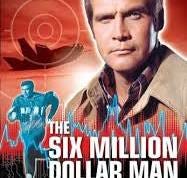
It was in March 1973 that a fictional bionic man appeared on television. Col. Steve Austin had bionic legs and eyes. At the same time, fact was catching up with fiction.

The “Six Million Dollar Man” Series was launched in March 1973 and ran until March 1978. It starred Lee Majors as a test pilot involved in a terrible accident. The government decides to “rebuild” him and give him superpowers. They invest huge amounts of money. Hence the title. In todays money he would be called the “$42m Dollar Man”.
At almost the same time pioneering UK surgeons learnt how to replace hips, knees and cataracted eyes. With current success rates above 95% these operations have become routine. They may not convey superpowers, but they have extended healthy ageing.
The first hip replacement took place in 1962, in the UK. The first modern lens replacement took place in 1967. This came with with the invention of phaco-emulsification. This was followed in 1968 by the first knee replacement. These were all invented by a single generation of surgeons.
A Five Minute Read
Returning Sight
The lenses of the eye are organic. The protein within them can degenerate and become cloudy. This creates blurred or foggy vision. The eyes become more sensitive to glare. Colours may fade. The first lens replacement was done by Sir Harold Ridley in the UK in 1948. He was able to remove the lens and replace it with a synthetic one. This involved a large incision in the eye. In 1967 an American surgeon invented a way of liquifying the old lens and removing it with suction. This enabled the incision to be reduced to a few millimetres. Modern cataract surgery took off.
650,000 cataract operations are performed annually by the UK National Health Service. The numbers are growing annually by 14%. The operation is now a “day surgery” taking less than half an hour. Success rates, as measured by patient outcomes, are over 95%. Globally it is estimated that there are between 20m and 28m operations a year. This is up from only 3.5m in 2000. Each operation represents the return of sight to an individual. Industry estimates suggest that within a year the operation to replace the 1 billionth lens will take place somewhere in the world. Cataracts are a disease of ageing. The average age at the time of surgery is 76. 1Bn older people have gained increased healthspan.
The Curse of Osteoarthritis
Osteoarthritis occurs when the smooth cartilage in the joints wears down. It thins out. That makes the movement of bone on bone rough. The result is pain, stiffness and restrictive movement. When the joints are in the hips and knees this can dramatically affect mobility. This is more important than one expects. It represents independence for people. It represents sociability. Those having trouble “keeping up” will often not engage in social activities. The result is often isolation and loneliness.
Hip and Knee Osteoarthritis is the 11th highest contribution to global disability. There is still a huge variation in the incidence of repair operations. The OECD average is 191.5 per 100,000 people but Germany has 310. The ageing population is driving some of this but clearly there are other factors at work. Mexico has only 8.6 operations per 100,000 population.
Hip and Knee Replacement.
These operations are driven by osteoarthritis. It represents the primary cause of 93% of all hip replacements. The most likely age of the operation is now 75-79 with a 60% bias towards women. There is a 95% success rate as defined by patients’ own assessment. They see measurable improvements in health and pain. Remarkably, the time in hospital is now below 3 days in the UK. The new hips are expected to last longer than the patients receiving them. The number of hip replacements per year in the UK is now over 100,000. Each represents a “permanent” improvement in mobility and health.
Six years later, in 1968, the first knee replacement took place. Again, in the UK. Success rates are as high. 95% of patients report a large improvements. Last year there were between 100,000 and 110,000 knee replacements in the UK.
The Bionic Future
Can bionic trainers save the day? Exoskeletons have been developed for the military. These full body suits enable solders to outperform normal definitions of strength and stamina. There is now an emerging industry offering partial exoskeletons as a consumer product. They are designed to augment existing movements. The promoters suggest that they would be worn everyday. They are “an e-bike for walking”.
The Dephy company is promoting "Sidekick".“ It consists of an adapted pair of trainers. These connect to a pack that straps to each calf muscle. This has batteries and sophisticated electronics. Its software can learn your gait in about 25 steps. It then provides powered help to make walking easier. (see link).
Not a Super Hero
These operations do not produce super heroes. They can however extend the enjoyment of life. The current generation are living longer than our parents. We have more years where health is important. That same generation has produced three medical breakthroughs. Each extends the enjoyment of life.
If you enjoy the Newsletter please recommend it to friends and send them to Substack to subscribe. It is free. Alternatively try the button below. All the Newsletters and lots more background is on my website thebusinessofage.com.