#263 Assisted Reproductive Technology
Can technology give couples the children they desire and halt the fertility decline?

In an earlier Newsletter I talk about the gap between the desired number of children and actual family size, (Newsletter #221 Reproductive Agency). I attended a research seminar recently which shed new light on the issue.
A Five Minute Read.
Defining Desire
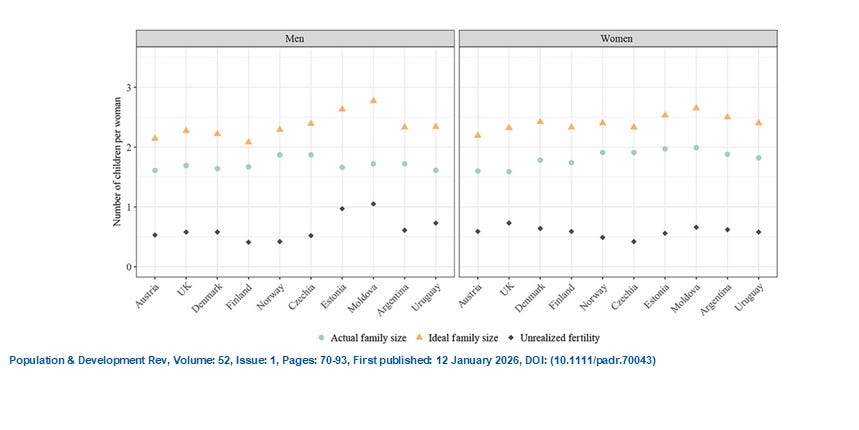
The gap between desired number of children and the actual has been well documented. Many of the studies measure a stated desire from young adults. Many years later they compare this with their subsequent families. This ignores the fact that during our lifetimes we may have perfectly good reasons to change our minds. Instead, a recent study looked at women who had just reached an age when they can no longer have children. It asked them retrospectively whether they had the children they desire.
Cross National Comparisons
This questions were included in a recent large international study. It turns out that the gap between desired and actual exists. Moreover it is reasonably constant across countries. The countries include more devloped nations such as Austria, the UK, Demark. They also include Estonia, Moldova, Argentia and Uruguay. Perhaps surprisingly the society and the medical infrastructures do not seem to have an effect. For women the ideal across countries averages just below 2.5. The resulting families have less than 2.
The Impact of Infertility
The age at women have their first child is increasing all over the world. A women born in theUK in 1978 is now passing childbearing age. They had on average one child per woman by age 31 years. Their mothers’ generation (born in 1951), had one child by age 26 years. Women born in 2007 can be considered to be the daughters of those born in 1978. They are projected to have an average of one child per woman by 35. For those born in 2025, this is forecast to occur by age 36. Fertility declines with age. Is infertility becoming an increasing issue in the gap between desired an actual family?
The vast majority of disappointment comes from women who were childless or only had one child. Disappointment was only as third as high for women with two or more children. The survey also asked these women whether they had an issue with fertility. 64% of women who were childless and did not have fertility issues were disappointed. For those with fertility issues, 93% were disppointed.
The Assisted Reproductive Technoloy (ART) Data

The first IVF in the world took place in 1978. Today there are estimated to be 8m people in the world born by IVF. This is a procedure that is highly regulated and documented around the world. The UK Regulator says that in 2023, 20,700 babies were born with IVF. They accounted for only 3% of all babies born. This compares with Denmark where 11% of all births involved ART. In Europe the next highest was Belgium at 5%
The percentage of babies born with ART varies by age. For women under 35 less that 2% of UK babies born involved ART. For the 35-39 age group that rose to just under 6%. However, for women in the 40-44 age group 11% of all the babies were enabled with ART.
The number of ART babies delivered to the under 35 year olds rose from 4712 in 2000 to 7939 in 2023. That is a 69% increase. The number delivered to the 40–44-year-olds increased by 330%. ART is increasingly involved in older women successfully having children. The success rates are lower 5% without donation. Twenty percent of all ART births involve donation of eggs, sperm or embryo’s. The majority to older women.
Will the Impact be Big Enough?
Data from Japan suggests that ART may be able to reduce the size of the “disappointment gap” by about a third. Japan has one of the highest incidences of ART. According to the latest comparative data, they provided 3603 IVF cycles per million of the population. This compares to a high of 5711 cycles in Isreal. That may be due partly to medical tourism. Denmark provided 3575 cycles. This is consistent with the 11% of all babies born this way. The USA offers only 922 cycles and China only 688. In absolute terms of course China leads the way with over 1m cycles, followed by the USA at just over 300,000.
How that provision is paid for varies dramatically. Provision in the UK is provided by the National Health Service in only 27% of cases. Couples are spending their life savings to continue treatment in the hope of a child. Companies vary dramatically in their support for employees going through this tortuous process. There is still pressure on women, especially, to feel a failure if they cannot conceive. Even though infertility in men seems to account for a third of all problems.
The Macro Problem.
UK baby girls born in 2025 are projected to have an average of 1.46 children throughout their life. The data suggests that they may look back at their childbearing years with disappointment. Fewer will have married and if they do it will be when they are older. They will have started families later. The incidence of infertility will be higher for them. Success rates for ART will have improved. It is 35% for couples aged between 18 and 34 today. Can the scale of the provision be created and funded to avoid that disappointment?
If you enjoy the Newsletter please recommend it to friends and send them to Substack to subscribe. It is free. Alternatively try the button below. All the Newsletters and lots more background is on my website thebusinessofage.com.
John, great and really interesting article as always Jan